


E-Invoicing in the UAE: Deadlines, Providers and Fines for 2026-2027
E-invoicing becomes mandatory in the UAE on 1 January 2027 for businesses with revenue of AED 50 million or more, and on 1 July 2027 for everyone else, VAT registered or not. From then, every invoice you send to another business or to government must go through an approved e-invoicing provider (an Accredited Service Provider, or ASP). A PDF sent by email will no longer count.
What is an e-invoice and how does it affect businesses?
An e-invoice is a structured data file, not a PDF or a scan. Your ASP sends it to your customer's ASP and reports the tax data to the Federal Tax Authority (FTA).
From go-live it changes your finance team's daily work, not just your software.
- Sending invoices. Invoice data goes from your software to your ASP, not out by email. A message then says whether it went through or failed, and someone must deal with failures.
- Customer records. An e-invoice can require your customer's Tax Identification Number (TIN) and trade licence number, so collect both from new clients.
- Supplier invoices. These also reach you through your ASP, so your approval steps may change.
- Corrections. Once an invoice has gone through, the FTA already has its tax data, so you reduce or cancel it with an e-credit note, not a corrected copy.
- Tax visibility. The FTA receives your invoice tax data in near real time, so your accounts and VAT return should agree with it.
- Running costs. You pay for an ASP, and possibly new software or a connector (prices below).
The upside, according to the Ministry of Finance: businesses in countries using e-invoicing have, over time, seen faster processing and payment, fewer disputes and quicker audit responses, and the UAE system could pre-populate VAT returns (UAE Electronic Invoicing Guidelines).
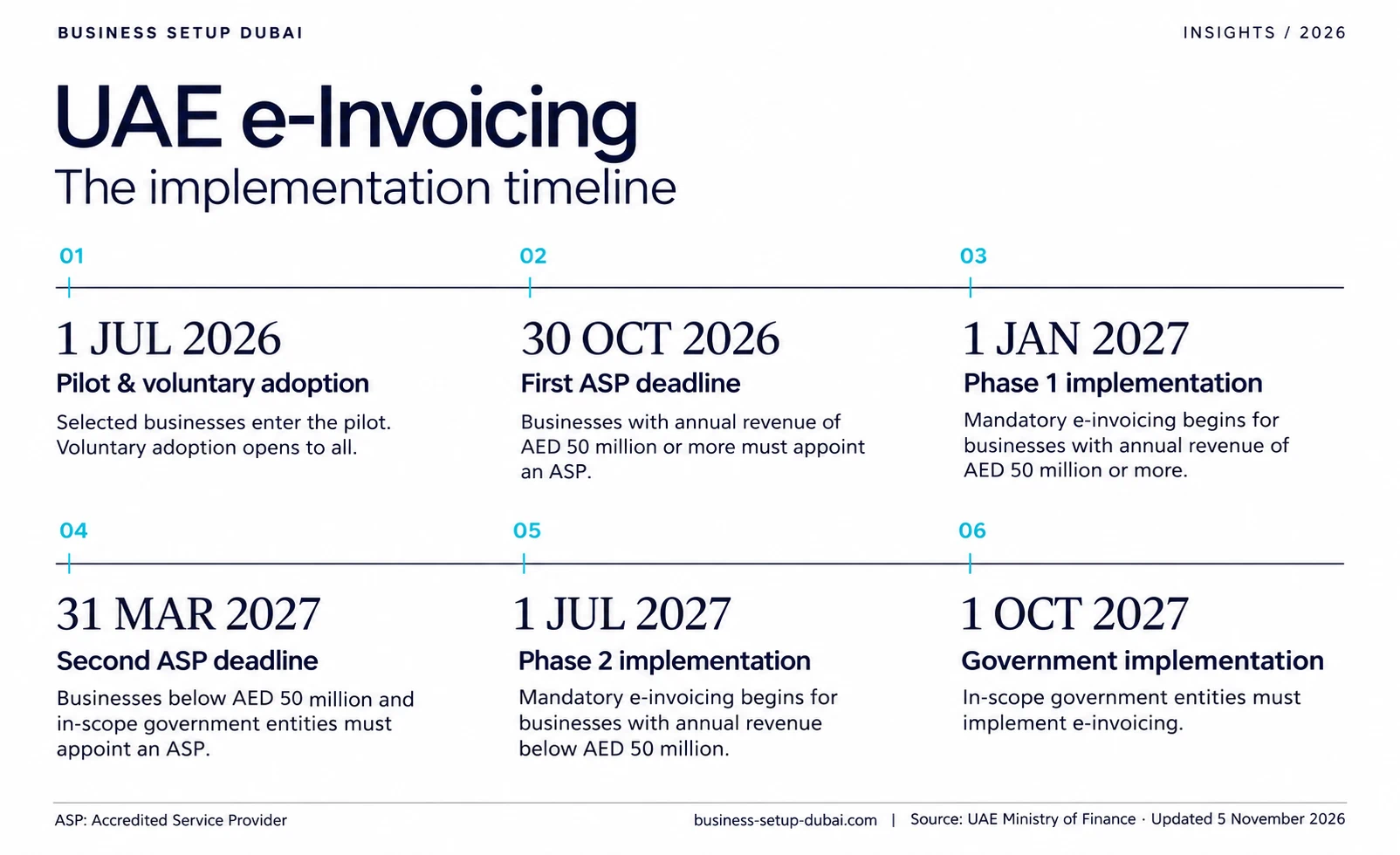
E-invoicing UAE deadlines: which date is yours
Your phase depends on revenue: the gross income in your latest financial statements, not your VAT taxable supplies or corporate tax taxable income.
| Who | Appoint an ASP by | Go live by |
|---|---|---|
| Revenue of AED 50 million or more | 30 October 2026 | 1 January 2027 |
| Revenue under AED 50 million | 31 March 2027 | 1 July 2027 |
| Government entities | 31 March 2027 | 1 October 2027 |
| Pilot group or any business joining voluntarily | Before joining | From 1 July 2026 |
The Ministry of Finance moved the large-business deadline from 31 July to 30 October 2026 and ruled out further extensions. That date has passed: a large business without a provider should appoint one now.
With AED 22 million in revenue, you appoint a provider by 31 March 2027 and go live by 1 July 2027.
Ready to start building your future in Dubai?
Talk to an expert about your project: free zone choice, licence, visas and banking, all handled for you.
Let's talk about your projectWhat is an ASP in e-invoicing
An ASP (Accredited Service Provider) is a company approved by the Ministry of Finance to send and receive e-invoices for you. Your accounting software connects to it, and it handles the format and the FTA reporting.
You cannot send e-invoices yourself: even software advertised as "FTA approved" needs an ASP. You use one ASP for both sending and receiving, chosen from the Ministry's accredited service providers list, which shows 86.
Five ASPs compared
| Provider | Best for | Software price | E-invoicing cost |
|---|---|---|---|
 Zoho | Small companies using Zoho Books | AED 90 a month, billed yearly (Professional plan) | First 100 free, then packs from AED 41 |
 Wafeq | Small companies wanting one simple app | From AED 57 a month, billed yearly | Included, according to Wafeq |
 Tally | Trading businesses tracking stock | AED 936 a year for one PC | Free and unlimited, according to Tally |
 TronStride | Small companies keeping their current software | E-invoicing only | 100 free a year, then from AED 1,470 a year |
 Fynamics | Larger companies on SAP or Oracle | E-invoicing only | From AED 4,500 a year, plus an onboarding fee |
Prices as published on 5 November 2026.
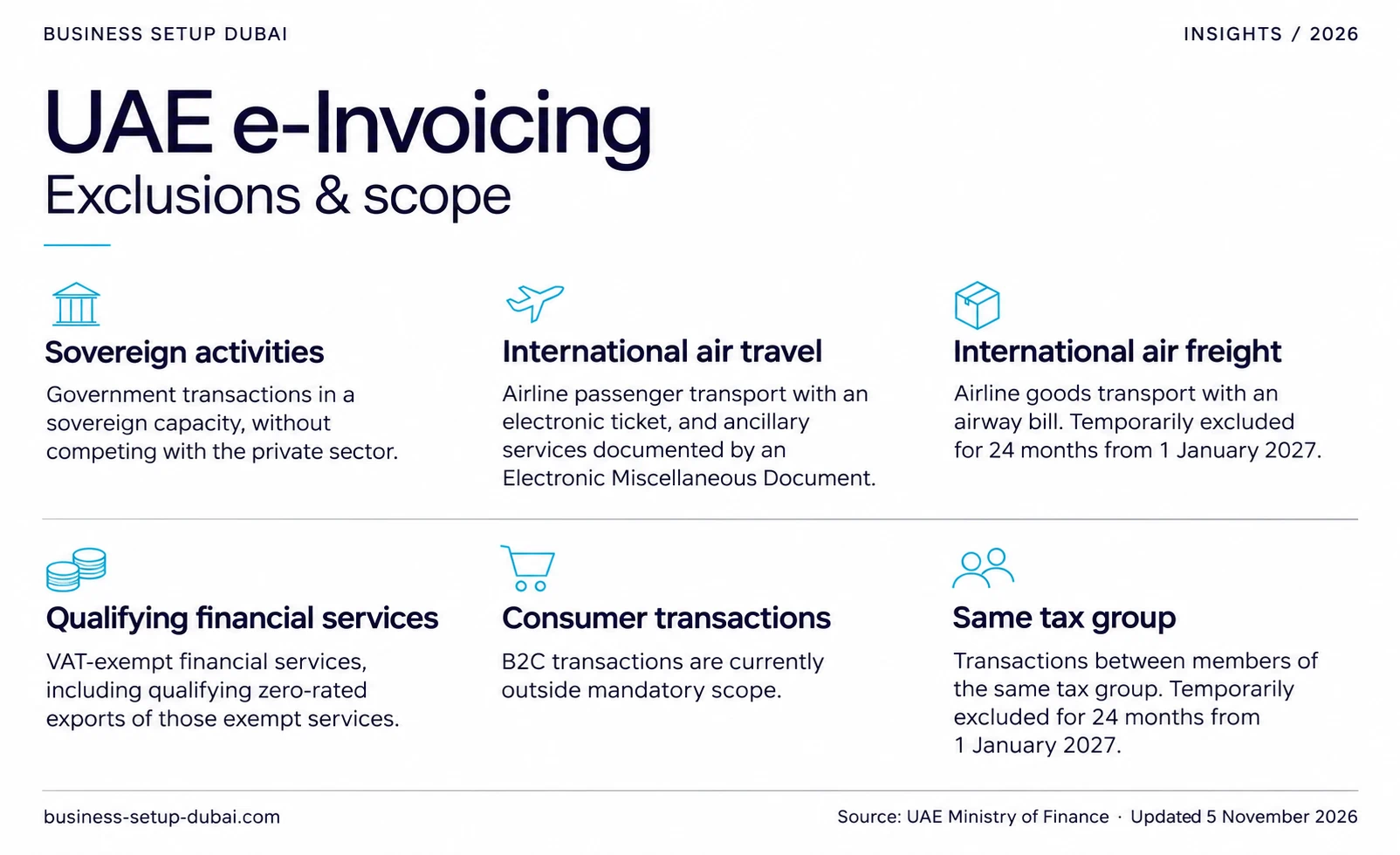
Who is in scope for e-invoicing in the UAE
E-invoicing applies to anyone doing business in the UAE, individuals included, whether or not they are VAT registered (Ministerial Decision No. 243 of 2025).
Find your situation. Open a row for the detail.
You sell to other companies or to governmentApplies to you
Sales between related companies count too; members of the same VAT group get a 24-month grace period from 1 January 2027.
You are not VAT registered but you bill other businessesApplies to you
You issue commercial e-invoices using a TIN generated through EmaraTax.
You are a freelancer or content creatorApplies to you
If you work regularly and independently, even with no company and below the VAT threshold: a freelancer invoicing client companies, or an influencer billing brands for paid posts.
You export to foreign buyersApplies to you
You still issue one. If the buyer is not on the network, your ASP sends it to a special export address.
You only sell to the publicDoes not apply
Sales to consumers are out for now. A café that also bills corporate clients is in.
You sell airline e-ticketsDoes not apply
Excluded. Air cargo under an airway bill is excluded for 24 months.
You provide VAT-exempt financial servicesDoes not apply
Excluded.
You are a government body acting in a sovereign roleDoes not apply
Excluded.
How e-invoicing works in the UAE
Your ASP converts your invoice to the UAE format and sends it to your customer's ASP, and at the same time both report the tax data to the FTA. Unlike in Saudi Arabia, there is no FTA approval before your customer receives the invoice and no QR code; the FTA confirms receipt of the data afterwards (UAE Electronic Invoicing Guidelines).
You and your customer can use different providers. Your "Peppol ID" is your e-invoicing address: 0235 followed by your TIN, which for a VAT-registered business is the first 10 digits of its VAT number (TRN). Each company in a VAT group has its own ID.
How to choose an e-invoicing provider in the UAE
Onboarding runs through the E-INVOICING tile in EmaraTax after you sign with an ASP. Before signing, ask:
- Does it plug into your software? Ask for a named, working connector for your ERP, not a CSV upload.
- Whose product is it? An ASP may run another company's platform. Ask who fixes a rejected invoice.
- What does it really cost? Pricing is subscription, per document or both. ASPs must commit to 100 free e-invoice exchanges a year; get that in the contract.
- Can you get your data out? Make export of your records on exit a contract term.
- What are the service levels? Uptime and support hours in writing: you must report a failure to the FTA within 2 business days.
- Does it handle your awkward invoices? Test free zone supplies, agents, retentions, self-billing and exports, not a standard invoice.
Need help with your accounting?
We handle your bookkeeping, VAT returns, payroll and corporate tax, and set up your accounting software.
See our accounting servicesWhat a UAE e-invoice must contain
A tax e-invoice has 51 mandatory fields and a commercial e-invoice 49 (your ASP will call this format PINT AE).
Fields most businesses do not capture today: a unit of measure code, gross and net item prices, and per-line AED amounts on foreign-currency invoices. You cannot add your own fields.
Invoices and credit notes must be issued and transmitted within 14 days of the transaction date.
Small businesses and free zones

Two things catch smaller companies out.
- Receiving before your own date. You need not receive e-invoices before you go live; until then, suppliers send to a placeholder address and must also give you a regular tax invoice, such as a PDF.
- Trading in your own name. Freelancers and creators with no company can register with their Emirates ID or passport.
| Jurisdiction | In scope? | What to watch |
|---|---|---|
| Mainland (DET and other emirates) | Yes | Trade licence number goes in the seller registration field. |
| Free zones, including Designated Zones | Yes | Mark the invoice as a free zone transaction. For a free zone customer, also name the "beneficiary", whoever uses or owns what you sold: usually the customer itself. |
A free zone company billing mainland customers under a DET permit e-invoices those sales like any other. See UAE free zones and setting up a free zone company in Dubai.
Small or not VAT registered? Check your readiness now
We confirm your TIN, clean your customer data and move you onto ASP-ready software before July 2027.
Book a readiness checkE-invoicing penalties in the UAE
Fines start when you miss your deadline to appoint a provider or to start sending e-invoices. A business that joins early by choice cannot be fined. These amounts are set by Cabinet Decision No. 173 of 2026.
| Violation | Penalty |
|---|---|
| Not implementing the system, including not appointing an ASP, or not staying compliant as a recipient afterwards | AED 5,000, then AED 5,000 for each further month or part of a month, up to AED 50,000 in any 12 months |
| E-invoice not issued and sent through the system | AED 100 each, up to AED 5,000 a month |
| E-credit note not issued and sent through the system | AED 100 each, up to AED 5,000 a month |
| Not telling your ASP of changes to your FTA registration data | AED 250 per day, up to AED 5,000 a month |
A large business with no ASP sending PDFs after 1 January 2027 can face up to AED 15,000 a month, before any VAT penalty. A business that is both issuer and recipient in the same violation pays only one penalty. Corporate tax fines are separate: see our guide to UAE corporate tax penalties and fines.
I have helped entrepreneurs set up in Dubai for 10 years, and e-invoicing is the logical next step after corporate tax arrived in June 2023. Businesses whose books are already kept properly by an accountant will cope. For everyone else, now is the time to get organised: waiting until the last month before go-live means risking AED 5,000 a month in fines while you look for an ASP.

E-invoicing readiness checklist
- Confirm your phase from gross revenue in your latest accounts.
- Check your TIN. No TRN? See our corporate tax guide.
- Update EmaraTax: trade licence, address and contacts must be current first.
- Map your invoice types: tax and commercial invoices, credit notes, self-billing, exports, continuous supplies, agent billing.
- Collect customer and supplier data: TIN or TRN, trade licence number and emirate for each.
- Run a gap analysis of your software against the 51 fields.
- Shortlist and sign an ASP using the six questions above.
- Onboard through EmaraTax and get your Peppol ID.
- Test end to end: sending, receiving, rejections and FTA confirmations. Joining voluntarily lets you test penalty-free.
- Set up the error process: who reissues within 14 days and who reports failures to the FTA.
Steps 4 to 6 are accounting work, not IT: our VAT services team handles them with your returns, and small business accounting moves spreadsheet books onto ASP-ready software. See also our guide to VAT in Dubai.
E-invoicing UAE: frequently asked questions
How long must e-invoices be kept?
Five years, seven for real estate, and longer while an audit is open. They can be stored outside the UAE if they stay complete, secure and producible on request.
Is a PDF invoice an e-invoice in the UAE?
No, not even if it carries the same information. An e-invoice is a structured data file sent through an ASP. During the rollout a PDF can go alongside it, never instead of it.
Does a holding company need e-invoicing?
A holding company with only passive income and no business transactions is out. Once it recharges management fees or costs to subsidiaries or third parties, it is in.
Does e-invoicing replace the VAT return?
No. VAT-registered businesses still file monthly or quarterly VAT returns through EmaraTax, and registration is still mandatory from AED 375,000 of taxable supplies.
For a view on your phase and a realistic ASP plan, book a consultation with our team.
Ready to start building your future in Dubai?
Talk to an expert about your project: free zone choice, licence, visas and banking, all handled for you.
Let's talk about your projectSources and legal basis
- Federal Decree-Laws No. 16 and 17 of 2024: create the e-invoicing system in the VAT and Tax Procedures laws.
- Ministerial Decision No. 64 of 2025 (ASP accreditation), amended by Decision No. 56 of 2026.
- Ministerial Decision No. 243 of 2025: scope, exclusions and obligations.
- Ministerial Decision No. 244 of 2025: pilot, voluntary phase and timeline, amended by Decision No. 66 of 2026.
- Cabinet Decision No. 173 of 2026: penalties (replaces Decision No. 106 of 2025).
- Ministry of Finance, UAE Electronic Invoicing Guidelines, version 1.1 (1 June 2026), and the accredited service providers list.